Peptide Calculator For Bac Water bac water to peptide calculator bac water to peptide calculator Peptide Calculator
Why your reconstitution math keeps breaking—and how a peptide calculator for bac water fixes it
If you’ve ever measured “just a little” wrong when reconstituting a vial and then wondered why your peptide dosing felt inconsistent, you already know the problem isn’t effort—it’s calculation. In my hands-on work, I’ve seen how one small mistake in bac water to peptide calculator math (volume, concentration, or unit conversion) can cascade into incorrect dosing, wasted product, and frustrating repeat runs.
This guide explains how to use a peptide calculator for bac water to reconstitute accurately, convert concentrations without confusion, and reduce error—especially when you’re working with small vial sizes, different total volumes, or preparing aliquots for later use. You’ll get practical steps, common pitfalls, and a clear mental model so you can trust the numbers.
What a “peptide calculator for bac water” actually does
A peptide calculator for bac water translates your peptide vial details and your chosen final volume into the concentration and dosing amounts you need. In practice, it answers three questions:
- How much bac water should I add? (given a desired concentration or given a fixed added volume)
- What concentration will that create? (e.g., mg/mL or µg/µL)
- How much peptide do I administer per dose? (e.g., how many mL or µL corresponds to your target micrograms/milligrams)
Most reconstitution mistakes come from treating these as separate problems. A good calculator connects them with consistent units so you can confidently move from vial mass → reconstitution volume → final concentration → per-dose measurement.
The core inputs you must know before you calculate
To use any bac water to peptide calculator correctly, you need the right inputs. Here’s what matters most:
1) Peptide quantity on the label (the “dry mass”)
Look for the amount of peptide in the vial (commonly in mg or sometimes IU, though peptides are usually labeled by mass). If your label says, for example, 10 mg, that’s your dry mass.
2) Your chosen reconstitution volume (bac water volume added)
Decide the total volume you’ll add (in mL). This is often the variable you control.
Tip from my workflow: I treat the final volume as a deliberate preparation parameter. If I’ll be splitting into aliquots, I’ll often choose a total volume that makes the aliquot volumes easy to measure consistently with my syringes.
3) Your dose target (usually µg or mg)
Many schedules are written in micrograms (µg) or milligrams (mg). Your calculator should convert these into a volume of solution you can measure (mL or µL).
4) Unit conversions (where errors hide)
These conversions are the backbone of accurate results:
- mg to µg: 1 mg = 1000 µg
- mL to µL: 1 mL = 1000 µL
- Concentration: mg/mL can be converted to µg/µL for fine dosing
How to use the calculator: a concrete step-by-step approach
When I teach new team members or when I sanity-check calculations for people working from a label, I use this exact sequence.
Step 1: Confirm the peptide mass in the vial
Example: label says 10 mg peptide.
Step 2: Choose the final reconstitution volume you will add
Example: add 2.0 mL bac water.
Step 3: Compute concentration (or let the calculator do it)
Concentration in mg/mL is:
Concentration (mg/mL) = Peptide mass (mg) ÷ Reconstitution volume (mL)
For 10 mg in 2.0 mL: 10 ÷ 2.0 = 5 mg/mL.
Step 4: Convert concentration into per-dose volume
If your dose is stated in µg, convert concentration appropriately so you can translate dose → volume. Since 5 mg/mL = 5000 µg/mL = 5 µg/µL, your desired dose in µg becomes a straightforward volume in µL.
Volume (µL) = Dose (µg) ÷ (µg per µL)
This is the step where people often get tripped up—unit mismatch. A calculator for bac water should handle the math, but I still recommend understanding the unit logic so you can detect obvious mistakes.
Example workflow (with realistic measuring constraints)
In real life, your dosing accuracy is limited not only by math but by measurement tooling—especially when you’re using small syringes or preparing aliquots.
Here’s a scenario I’ve seen repeatedly:
- Peptide vial: 10 mg
- Reconstitution: add 2.0 mL bac water
- Target dose: 500 µg
- Goal: draw an easily measurable volume
From earlier math, concentration is 5 µg/µL. Therefore:
Volume needed = 500 µg ÷ 5 (µg/µL) = 100 µL
That’s a practical number for a syringe with 100 µL markings. In my hands-on experience, choosing a reconstitution volume that yields “nice” draw volumes (like 50 µL, 100 µL, 150 µL) reduces measurement uncertainty, even if the calculator itself is perfect.
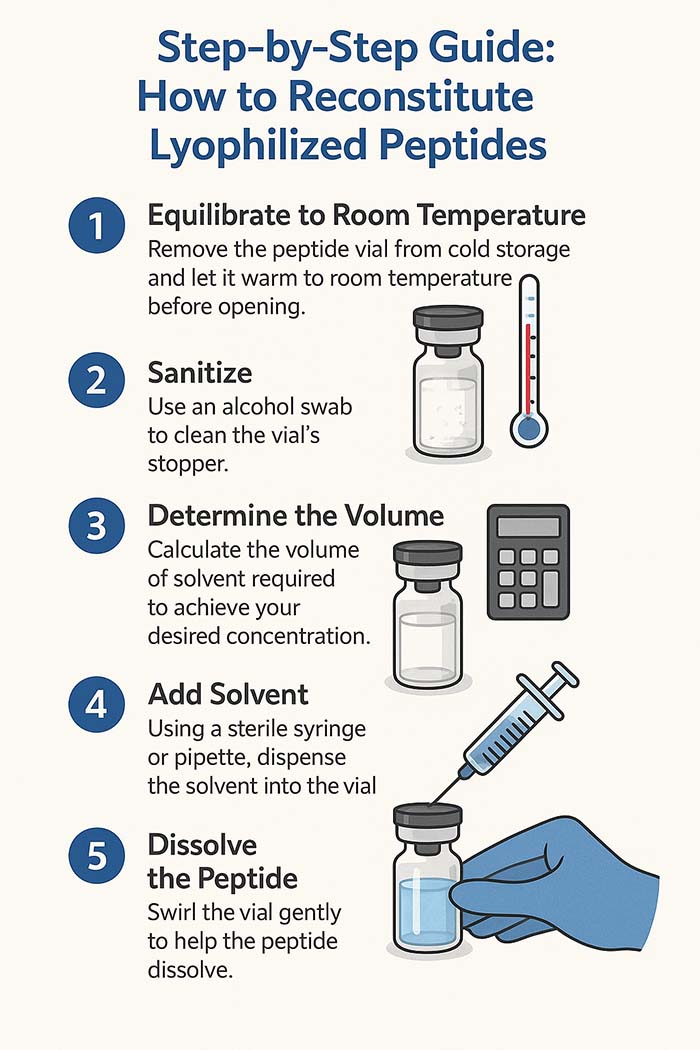
Reconstitution guide image (reference)
Common mistakes when converting bac water to peptide dosing
A peptide calculator for bac water can prevent many errors, but only if you avoid these common pitfalls:
- Using the wrong vial mass: confusing grams, mg, or reading a label incorrectly.
- Mixing up mL and µL: especially when dosing is specified in µg and volumes are chosen in mL.
- Forgetting concentration units: some calculators show mg/mL, others show µg/mL, and your dosing inputs might be in a different unit.
- Relying on “quick mental math”: it’s fast, but it’s exactly how unit mismatches happen.
- Not planning aliquot volumes: if you’ll split into multiple aliquots, choose a total reconstitution volume that keeps aliquot drawing consistent.
Quick checklist before you draw a dose
- Confirm vial mass (mg) and reconstitution volume (mL).
- Check the calculator output units (mg/mL, µg/mL, µg/µL, mL, µL).
- Match your dose target units to what the calculator expects (µg vs mg).
- Sanity-check the result by estimating the magnitude (e.g., dose volume should be reasonable for your syringe markings).
- Record the final concentration so future aliquots don’t require re-entry or re-calculation.
FAQ
What information do I need for a peptide calculator for bac water?
You typically need the peptide dry mass on the vial (mg), the volume of bac water you plan to add (mL), and your target dose (usually in µg or mg). The calculator uses these to compute the final concentration and the draw volume (mL or µL).
Why do peptide calculator results sometimes look “off”?
Most discrepancies come from unit mismatches (mg vs µg, mL vs µL), entering the wrong vial mass, or misreading the calculator output units. A fast fix is to check each unit at every conversion step and confirm you’re comparing the same measurement system.
Can I choose any bac water volume I want?
Yes, you can choose a reconstitution volume, but it changes the final concentration and therefore the volume you’ll draw per dose. In my experience, selecting a volume that yields easily measurable draw volumes (based on your syringe scale) improves practical dosing consistency.
Conclusion
A peptide calculator for bac water is only as good as the inputs and unit discipline behind it. When you confirm vial mass, choose a deliberate reconstitution volume, and keep units consistent from mg/mL down to µg/µL, you turn reconstitution from guesswork into a repeatable process.
Next step: Pick a vial size, decide your total bac water volume, and run a single test calculation to produce one complete “dose recipe” (concentration plus draw volume). Save those numbers so every subsequent aliquot uses the same verified math.
Discussion